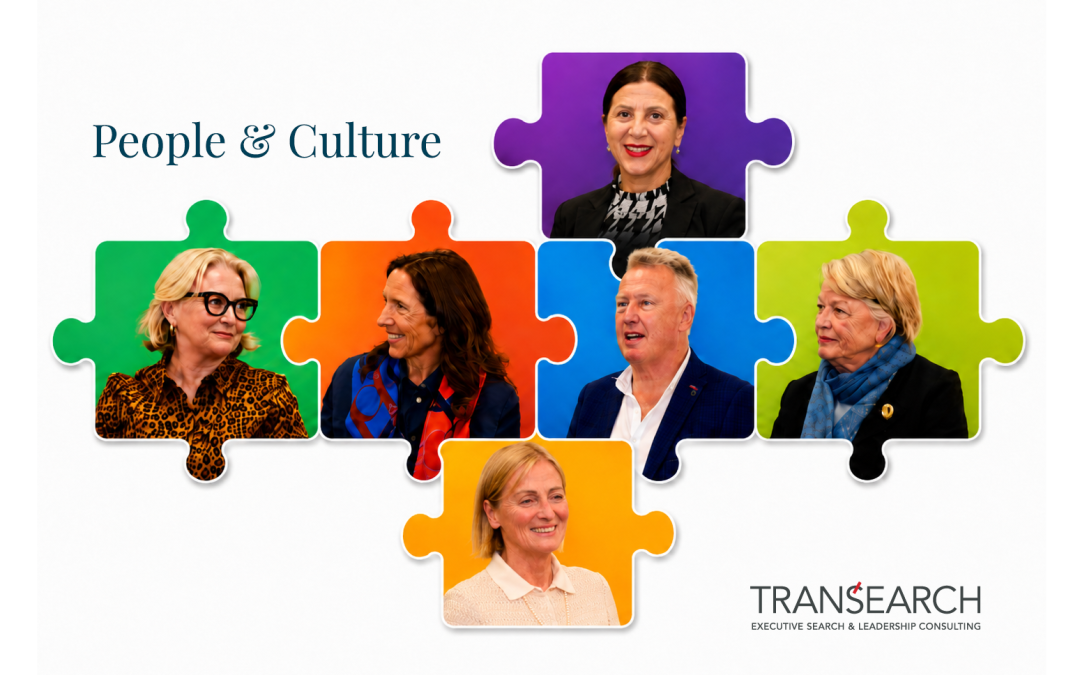
There was great energy in the room when a full house of senior People & Culture executives gathered for CPO to Board: Impact and Influence, the latest in our quarterly P&C Roundtable series. I hosted the event alongside Peter George, Managing Director, Prima Group. Our panel, moderated by Anita Ziemer, Executive Director, TRANSEARCH Australia, brought together Meahan Callaghan, James Kelly, Kate Temby and Sheena Wilson, each a Non-Executive Director (NED) or Chair with a genuinely different vantage point on board life and the pathway for a Chief People Officer (CPO) to take (or not) into it.
The starting question was simple enough: How does a CPO make the transition to the boardroom?
However, it didn’t take long for a harder question to surface: Why, given how central people in an organisation and workforce capability are to performance, are there still so few CPOs at Australian board tables?
That’s really what the session ended up being about.
Meahan Callaghan approached it as someone who has made the leap. Formerly CPO at Afterpay and Redbubble, she’s now building a portfolio on the board and advisory side. Sheena Wilson, Chair of Women on Boards Australia, has taken the longer route through HR and global talent leadership, into a CEO role, and now onto boards. Kate Temby, a Non-Executive Director at Netwealth who chairs its People & Corporate Sustainability Committee, spoke from the other side of the table about what a good CPO brings to a board. And James Kelly, who co-founded Lifestyle Communities and later chaired Hamlet Living, talked about his own CPO as one of the most important people in his business.
It became obvious that this wasn’t going to be a “How to land your first board seat” session. It focussed on having relevance as a NED – what boards need from People & Culture leaders now – and whether the function is keeping pace.
Learning not to have the answer
One of the more honest moments came when Meahan talked about having to unlearn something. As an executive, you’re rewarded for knowing what to do and getting it done. On a board, that instinct can work against you. You’re not there to run the function from the boardroom or prove you’d do it better. Your value is in your judgement, the questions you ask, the challenges you bring.
It sounds like a small shift. It isn’t. Swapping “Here’s what you should do…” for “What happens if we go this way?” or “What haven’t we considered?” takes a while to feel natural, especially for people who’ve spent their careers being the one with the answer.
Getting the board to hear what it needs to hear
There was a good chunk of conversation about the gap between what boards usually see (engagement scores, turnover, diversity numbers, succession charts) and what they need to see (and understand).
Some of the questions the panel thought boards should be asking more often include:
- Which capabilities are walking out the door?
- Where is the business too reliant on one person?
- Do we have the leadership bench for the strategy we’re chasing?
- What’s bad behaviour costing us?
- Is the employee experience showing up in how customers feel?
- What does AI do to the skills we’ll need in five years – which ones matter more, which ones stop mattering at all?
The thread running through all of it: a CPO has more impact once they stop speaking HR and start speaking the language the rest of the board already understands (risk, capability, cost, customers, reputation, strategy). Meahan put it well: sometimes you need to walk into the room thinking less like a Head of HR and more like a Chief Risk Officer.
That lands because a lot of what a CPO knows isn’t comfortable. The CEO’s read on the culture might not match what staff are experiencing. There might be leadership behaviour quietly creating risk. There might be problems the data hasn’t caught up to yet. Getting that in front of the board, and having it land, takes more than a good report. Trust, built over time, particularly with the CEO, the Chair, and often the Chair of the People or Remuneration Committee, is invaluable. Speaking up when it’s uncomfortable is part of the job, but doing it credibly means being able to separate what’s organisational risk from your own opinion.
Building the case before you need it
Someone in the room asked the obvious question: What should a CPO be doing now if a board seat is the goal down the track?
Sheena’s answer was refreshingly unglamorous: get involved in things outside your lane before anyone’s asking you to. Put your hand up for the M&A deal. Get into the transformation project. Sit in on the capital raise. Learn the commercial model properly. Spend time with customers. It’s not about ticking boxes; boards don’t want someone who only lights up when the agenda reaches the “people” item. They want someone who can be part of the whole conversation.
James backed this up from the CEO chair. At Lifestyle Communities, his CPO was never confined to a lane; growth, acquisitions, most big calls had a people dimension too significant to leave out of the room.
Kate made a similar point in a different way: a CPOs influence doesn’t come from the title. It comes from being relevant to the business, full stop.
When the conversation turned to AI
AI tends to be talked about as a technology problem, or purely as a cost and productivity play. The panel pushed back on that framing. What happens to the workforce? How do roles shift? How do you reskill people at scale? And how do you keep any trust intact while all of that’s happening?
There was a shared view that this could turn into one of the biggest workforce transformation challenges organisations have dealt with. CPOs who can link technology, organisation design, capability and people have a real chance to lead through it, not just manage the fallout. That’s exactly the kind of experience boards will want in the room.
The real question is different
One idea near the end of the session stuck with a lot of people: Why do organisations have a business strategy and then, separately, a people strategy?
Growth needs capability. Transformation needs leadership. M&A needs cultural integration. AI needs workforce transition. None of that is separate from “the strategy”; it is the strategy.
So perhaps the task for NEDs with a P&C or HR background isn’t convincing boards to make room for people considerations. It’s pointing out they were never actually separate to begin with.
We started the session talking about how CPOs get onto boards. We finished talking about why boards might need them there.
Thanks to Meahan Callaghan, James Kelly, Kate Temby and Sheena Wilson for being so open about their experiences, to Anita Ziemer for steering a genuinely good conversation, and to Peter George, David Mahony and the Prima Group team for partnering on the day.
Silvana Pardo hosts these conversations regularly across the TRANSEARCH Australia network. This session was very much in keeping with why the series exists in the first place. Each event is built around a topic that matters to P&C leaders right now, and this one went to the heart of something Silvana has long advocated for: People & Culture deserves a genuine voice at the board table because the perspective it brings is strategic in its own right. If you are interested in participating in future events, please get in touch directly.
Silvana Pardo is a Director of TRANSEARCH International Australia, one of Australia’s most progressive executive search firms and one of the leading executive search organisations in the world. With over 25 years of experience and an extensive business network of Human Resource professionals, Silvana enjoys an outstanding reputation as one of Australia’s leading Search Practitioners. Read more…